41 Sorting Activities for Preschoolers


Yesterday I posted about Matching Activities, and today I have 41 Sorting Activities.  Some of the sorting and matching activities are interchangeable, but for the most part I tried to have new activities on this post.  Like I said in my last post, many of these ideas you can definitely make into DIY projects.  Click on the pictures for the amazon info.
Letter/Object Sorting
Letter/Object Sort
Animal/Color Sort
Colors
Color Baskets
Bears with Cups (I usually use Easter Egg Dye Cups)
Shape Sort
Beginning Letter Sound
Bugs
Pictures
Buttons
Bugs
Fruit
File Folder Games
Colored Objects
Shape/Color/Size
What Goes Together
Letters
Links/Colors/Shapes

Money
Emotions/People

Pencils

Pie

Recycling

Colors

Staircase

Clothes

Shades of Color

Transportation

Colors

Colors/Shapes/Objects
10 More Ideas
  • Seasonal activities or clothes-take pictures, or find flash cards to sort.
  • Kids - Find pictures of different kids and sort by different characteristics (i.e., boys and girls, short and tall, long and short hair, color of clothes, happy and sad, etc.)
  • Texture - Find different objects around the house and sort them according to how they feel.
  • Quantity - Take pictures of objects, and sort by how many objects are in the picture.
  • Size - Sort random objects by size
  • Weight - Light as a feather or Heavy as a brick
  • Smell - Make smelling bottles, and they can sort according to what they think they are.
  • Likes/Dislikes - Have your child make piles of pictures of things they like and don't like.
  • Hot/Cold - Microwave objects and put objects in the freezer, then when it's time for the activity, they can be sorted.
  • Money/Wallet - Put the paper money in a wallet, and the coins in a coin purse.
Joy Mano
Utah PLAY Project Home Consultant
Early Intervention Treatment for Children With Autism

41 Matching Activities for Preschoolers


Over the next several days, I'm going to post ideas to use with your Activity Schedule.  Many of these activities you can probably make yourself, but hopefully this will just give you somewhere to start.  Click on the pictures to get the amazon info.
Bead Sequencing
Bingo Bears
Color Cookies
Cupcake Sorting
Sort & Snap Color Match
What Goes Together
Match Me Game Colors & Shapes
Photo Opposites
Memory Game Cards
File Folder Games
Mix and Match Doughnuts
Non-identical picture matching
Pattern Blocks and Boards
Shape & Color Sorter
Stack and Sort Board
Shape Sequence Sorting
Shape Sorting Cube
Cookie Shapes
Bear Puzzle-Take pictures and make it a matching game
Sorting Shapes Cupcakes
Laundry Jumble Game
Alphabet Picture Match
Object Picture Match

Shape Sorting Center - One side of board is sorting, the other side is matching
Farm Sorting
Match and Learn Money Center
Rhyming Words - I've seen these games at TJ Max for about $6 before
Puzzles
Egg Shape Sorter
Matching Emotions
The last 10 ideas that I've used in the past, I don't have pictures for, but I'll give you a pinterest link of others who have done the same activity.
Joy Mano
Utah PLAY Project Home Consultant
Early Intervention Treatment for Children With Autism

Activity Schedule-Learning Independence

There's so much a child can learn from their own Activity Schedule.  This is something I learned about during one of my Discrete Trial workshops.  I love PLAY, but I also love learning different interventions as well :)  This can also be adapted for the home.

Here's how to get started.  I will highlight in red, skills the child is working on.

-These are the $1 photo books from Walmart.
-I put the child's name on the front cover.-Name Recognition. You can also use letter links, photos, etc.
-Each child's book has 4-5 different activities they need to complete, they must finish them in order-Sequencing.

-Each box has a picture on it that matches the pictures in the student's books.  (I use either pecs, photos, or images off of google images)-Matching with distance (looking at the picture in their book then walking to the shelf and remembering which picture they are looking for)
-Stay tuned for the next several posts, I'll be posting activity ideas to go along with your Activity Schedules.  **The important thing to remember is that the purpose of the Activity Schedule is for the child to become independent.  So, when you are choosing activities, you should choose activities you know the child can do independently already.  The purpose of this is not to teach new skills with the box activities.  They should be taught prior to using them in the Activity Schedule.
-Other ideas-you could do this for chores, getting dressed, getting ready for bed, etc.
-After each activity, the child cleans up and puts their box back on the shelf before moving on to the next page. -Clean up


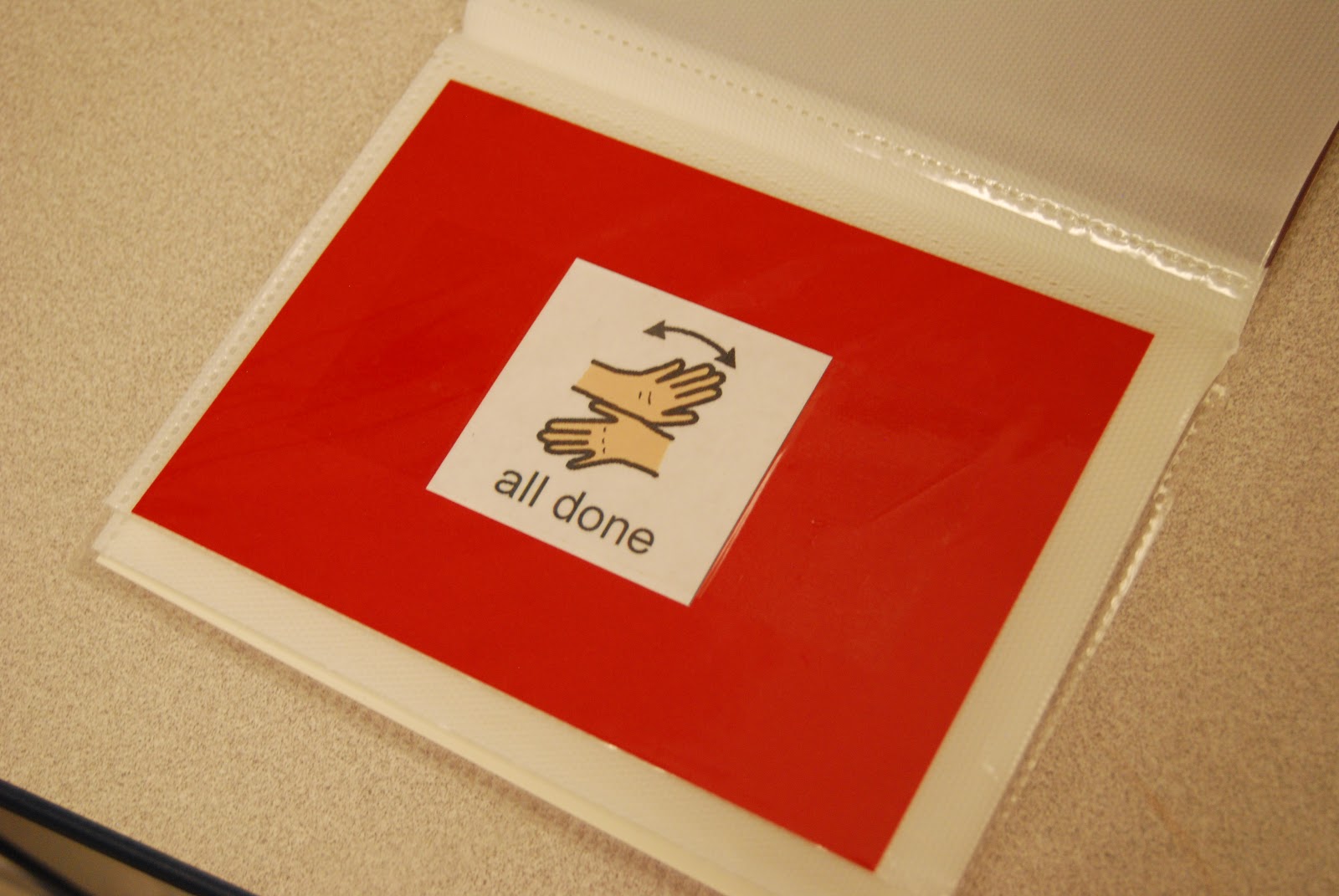
-The last picture I have in each book is an 'all done' pec.  It's amazing how quick all the kids catch on to this one.  They will all try at one time or another to get to this page first.

-When my kids get to this page they know to put their book away on the shelf, turn their book over and take off the icon on the back that tells them where to go next. -transitioning, and matching


-In my class, purple oval means free play time.  That's why all the kids want to get there as fast as possible.  Once they put their purple oval in the envelope, they're free to play.  The funny thing is that a lot of the kids will go and do their books again, just for fun. -finishing their work before receiving an incentive.

*When a child is first learning how to do their activity schedule, they will need assistance.  Some kids may become prompt dependent if verbal prompts are used.  Depending on the child, you may want to consider only doing physical prompts (no talking) then slowly backing off until they are dependent.

*I usually changed the activities weekly or biweekly.  Some kids will memorize the order the pictures are in, so occasionally I would mix the pictures up during the week.


Joy Mano
Utah PLAY Project Home Consultant
Early Intervention Treatment for Children With Autism

Special Education Acronyms

When your child has a CA of 3, you will have his IEP at the CDC where you will discuss the LRE with the LEA for your child with ASD because he will no longer be on an IFSP.  OK? OK...

I worked with people with developmental disabilities in various settings before I started working in Education.  Yeah we had acronyms too, but when I started teaching, EVERYTHING had an acronym.  I did the alternative route to licensure, so I taught my class while I was going to school to get my Educators License.  So basically, I was just thrown into the school environment, acronyms and all.  Most of the time I would just smile and nod, and then I'd go look up the acronyms later.  Confusing...it was confusing.

I'm sure many parents use my same technique of smile and nod, smile and nod.  Especially when they're new to the world of special ed.  Now some teachers are better at explaining things than others, but some teachers forget that not everyone speaks the acronym language.

So here we go, here are a few of the acronyms.  I couldn't do all of them since there are hundreds of them, but it's a start :)

For more acronyms, you can go to the Utah State Office of Education site, or the Utah Parent Center site.  This list was compiled from their two lists.

Joy Mano
Utah PLAY Project Home Consultant
Early Intervention Treatment for Children With Autism

Grocery Shopping Intervention for Kids With Autism


My last post addressed why grocery trips can be difficult for a child with autism.  Now let's discuss a few techniques that can be used to make grocery trips more successful.

First, let's define success.  What does that mean to you?  To each family it will probably be something different.  This is like writing IEP goals for the grocery store :)

Here are some ideas (try to keep them with positive verbiage, rather than focusing on what you don't want to happen):
  • When we go to the grocery store we will have inside voices the whole trip.  
    • This is actually not specific enough, you may need to define how long the trip is going to be.  And then ask yourself if that's realistic.
  • When we go to the grocery store we will keep our hands in the cart at all times.
    • Once again, you'll want to define for how long.  Are you expecting your child to do this for 10 minutes or 2 hours?  And what is realistic.
  • When we go to the grocery store we will keep our clothes on.
Ok, you get the picture.  Figure out your expectations.

Next step is to create successful experiences.  If you know that your child generally keeps a quiet voice for the first half of the grocery trip, and then starts yelling half way through, go with that.  Go to the store for half the time.  Make intentional trips to the store, not with the intention of getting everything on your list, but with the intention of making the trip "successful" for your child.  

The purpose of these trips is not to check things off your list, the purpose is to have a positive experience with your child at the grocery store.  They need to know what it feels like to be successful.  Obviously, there are days that you need to get your groceries, these are not the trips I'm talking about right now.   These are the planned teaching moments to the store.

Here's some tips
  • Make a short trip to the store (less than 5 minutes) to get maybe just one item.
  • Talk about what you're going to do before you go (even if your child is non-verbal, this is still an important step) If you have a social story, or even pictures of what you're going to do, visuals are always great.  You can go over this story throughout the week, the day of, in the car before ou get out, however much prep you think your child needs.
    • We are going to walk into the store and we will find the aisle with the bread.  
      • Take the picture of bread with you so you can remind your child what you're getting, or so that he/she can help you find it.
    • We'll need to remember to use our inside voices in the store.
    • Then we'll go to the cash register to pay for the bread.
    • And then we will go home in the car.
    • Then stick to the plan.
  • Keep your attention on your child, interacting with him/her as you walk to get that item
  • If you normally want your child in a cart when you're shopping, you'll still want them to be in the cart even if you're buying just one thing.  Try to make things the same as they would be if it were a long shopping trip, because this is a learning experience for them.
  • Compliment your child on the positive behavior you are seeing and looking for
    • "I really like how you're talking with your inside voice."
    • "You are walking so nicely, I love it!"
    • Saying "good job" is not specific enough, they need to know what exactly it is that they're doing that you like.  They're more likely to do it again in the future if they know.
  • Go during the day when you know lines/wait time will be short.
  • As you are leaving the store, praise, praise, PRAISE your child.
    • "You did so great!  I am so proud of you for keeping your inside voice the whole time we were in the store!"
  • In the car, praise your child.
  • When you get home, brag about your child to your family!
  • Did I mention to use positive reinforcement?  :)
  • After the successful trip, go do a fun activity...while praising your child about what they just accomplished.
  • Disclaimer:  Using tangibles (like a treat from the store) can be dangerous, not for the moment but for the future.  If you start to reinforce your child by buying them something they want from the store they may expect it every time, and it may cause future meltdowns when you have to say no.
Repeat the process.  Repeat this experience on another day, but go for a few minutes longer, get 2-3 items instead of just one.  Increase the time you are in the store after each successful trip.

If your 5 minute trip is unsuccessful, revamp your plan.  Does your trip need to be a walk in the door, say hi to the greeter, and leave?  It's ok if it does.  You have to start somewhere.  Even if your trip is unsuccessful, please still praise your child for the things that they did right.  For every negative thing a child hears, they should hear AT LEAST 4 positives.

Joy Mano
Utah P.L.A.Y. Project Home Consultant
Early Intervention Treatment for Children with Autism

photo credit: onenjen via photopin cc

Sensory Overload - The Grocery Store and Autism

I'll be completely honest, I've come really close to tears while shopping before.  First it was just a rough week, second I really dislike shopping (any kind of shopping, if I had a wish, I'd wish for a personal shopper), and third after shopping for about an hour and half and with groceries for home and groceries for my class I had half of my stuff on the conveyor belt and realized I didn't have my wallet.  AAAAHHHH!!! That's what I wanted to scream, and I kind of wanted to lay on the ground and scream (until I thought about the floors at the store, and then I really didn't want to touch them.)

For some kids with autism or other developmental disabilities or really any kid (or adult), shopping is not a pleasant experience.  I'll focus on ways to help enhance the experience in another post, but for today I want to focus on why grocery stores can cause sensory overload.   Just a list of things to think about, it won't apply to all kids, but you'll know if it applies to your kid.

  • Grocery Carts
    • Cold
    • Hard
    • Uncomfortable
    • Child is facing the wrong direction (if child is sensitive to movement, this could cause issues)
  • Visual Stimuli
    • Fluorescent Lights 
      • Some kids are very sensitive to the flickering of these kind of lights
    • Stuff everywhere
      • Visual overload can equal chaos
      • Things out of order-for the orderly child = problem
      • Lots of fun stuff...that he/she can NOT have...but he/she WANTS!
      • Depending on the floors, there may be lines that need to be followed, or patterns that should be followed.  You know, the rules they know, but we don't.
    • People everywhere-and sometimes they come and get in the child's face to say how cute they are, or they pat them on the head.
  • Smell
    • Think of the mixture of smells in this place
      • Foods
      • Perfumes
      • Odors
  • Auditory
    • Lights buzzing
    • Freezers humming
    • Footsteps from every direction
    • Phones ringing
    • Adults talking on phones
    • Children crying
    • Cash registers beeping
    • Conveyor belts going and stopping
    • The butcher's machines slicing
    • Squeaky grocery cart wheels
  • Time
    • Sometimes the amount of time required in a grocery store is just too long!  That's how I feel anyway.
    • Waiting in lines
      • Boring
      • Lots of temptations around that you're not supposed to touch
      • People standing too close
  • Attention
    • Parents attention is not focused on the child, but on the shopping (so it can get done as quickly as possible.)
Joy Mano
Utah PLAY Project Home Consultant
Early Intervention Treatment for Children With Autism

photo credit: B Tal via photopin cc

Our Sensory Systems and Learning

The past few days I have felt really dizzy, not sure why yet.  Today has been the worst of the dizzy days so far.  I feel off balance, every time I move my head I feel a little more light headed, things aren't really spinning around me but if I close my eyes then I start to spin.  I feel like I am in a bubble and things aren't quite clear outside of that bubble around me.  It's a really weird feeling, and I'm sure many of you have felt that way before.

It just got me thinking about our kiddos that are sensitive or over reactive to vestibular movement.  If this is how they feel all the time, I can see how it could make them want to scream or run away (or maybe walk slowly away, running would make me sick right now) and hide in a small dark space where things aren't attacking their senses.

I really just don't want to do anything right now because it makes me even more dizzy.  Have you seen this chart before?'


I like showing this chart to parents to point out that our sensory systems are the foundation of learning.  If our sensory systems are out of whack (like mine is today) then it makes learning very difficult.  As you can see there is a lot that goes into preparing for academic learning as that is the top of the pyramid.   I see a little more clearly why it would be difficult to learn in the state that my sensory system is in today.  

Joy Mano
Utah PLAY Project Home Consultant
Early Intervention Treatment for Children With Autism